

Apartment facades define the character of urban neighborhoods and shape how residents experience both their homes and the street. The best examples balance aesthetic ambition with practical concerns like natural light, privacy, and climate response.
This collection explores thirty distinct approaches to residential facade design, from material-driven solutions to geometric experimentation, offering practical insights into what makes each strategy effective.
Table of Contents
1. Undulating Concrete Balconies Create Movement

Curved concrete balconies arranged in a continuous wave pattern transform a straightforward apartment block into a sculptural composition. The undulating rhythm breaks up the facade’s mass while creating unique outdoor spaces for each unit. Glass railings preserve views and emphasize the flowing geometry.
The success of this approach depends on the interplay between solid and void. Morning light catches the curves differently at each level, casting shadows that shift throughout the day and accentuate the three-dimensional quality of the design. This dynamic relationship between form and light gives the building visual interest without relying on applied ornament or color.
2. Pixelated Massing with Integrated Greenery

A stepped facade where individual apartment units push forward or pull back creates an irregular, pixelated silhouette. Each shift in the facade generates a private terrace, ensuring outdoor space for residents in a high-density context. Climbing plants cover the building, softening the geometric composition and improving air quality.

This design strategy addresses two urban challenges simultaneously: the need for density and the demand for private outdoor access. The vertical variation also reduces wind pressure on the facade and creates microclimates that support plant growth. By integrating greenery into the massing concept rather than treating it as an afterthought, the building achieves a genuinely biophilic character.
3. Expressionist Brick Detailing with Color Gradation
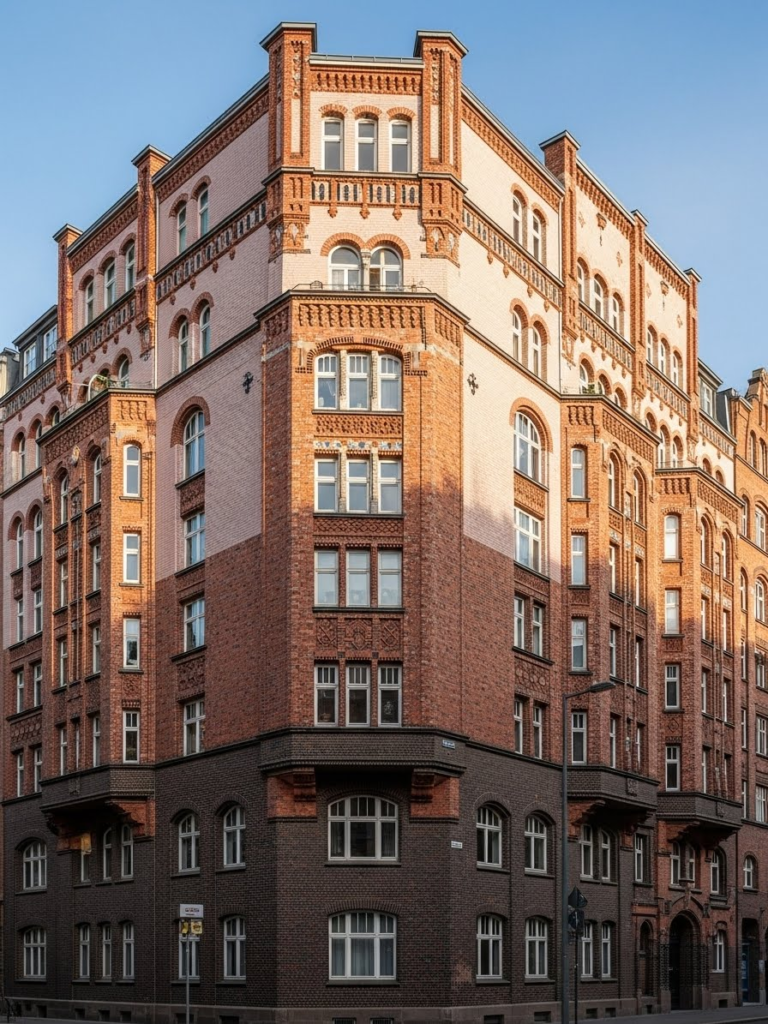
Brick expressionism uses the structural material itself as the primary decorative element. Here, intricate masonry detailing and arched window openings create visual complexity without additional cladding systems. The gradient from dark red at the base to light pink at the top gives the building a sense of lightness as it rises.

The gradient technique has practical roots—darker materials at street level hide urban grime better—but also creates a perceptual effect that makes the building feel taller and less massive. The craftsmanship required for such detailed brickwork represents a return to traditional construction values, where the skill of the mason directly influences architectural quality.
4. Adaptive Timber Shutter System

A grid of movable timber shutters allows residents to control light, privacy, and ventilation while constantly changing the building’s appearance. Some shutters remain open to reveal glass behind, others close completely, creating a dynamic checkerboard pattern that shifts daily. The wood brings warmth to an otherwise modern composition.
This interactive facade responds to individual preferences rather than imposing a single aesthetic. The system also improves energy performance by shading glass during hot hours and opening to capture daylight when needed. The visible evidence of human activity—shutters adjusted differently on each floor—makes the building feel lived-in and responsive rather than static.
5. Bauhaus Geometry with Color Accents
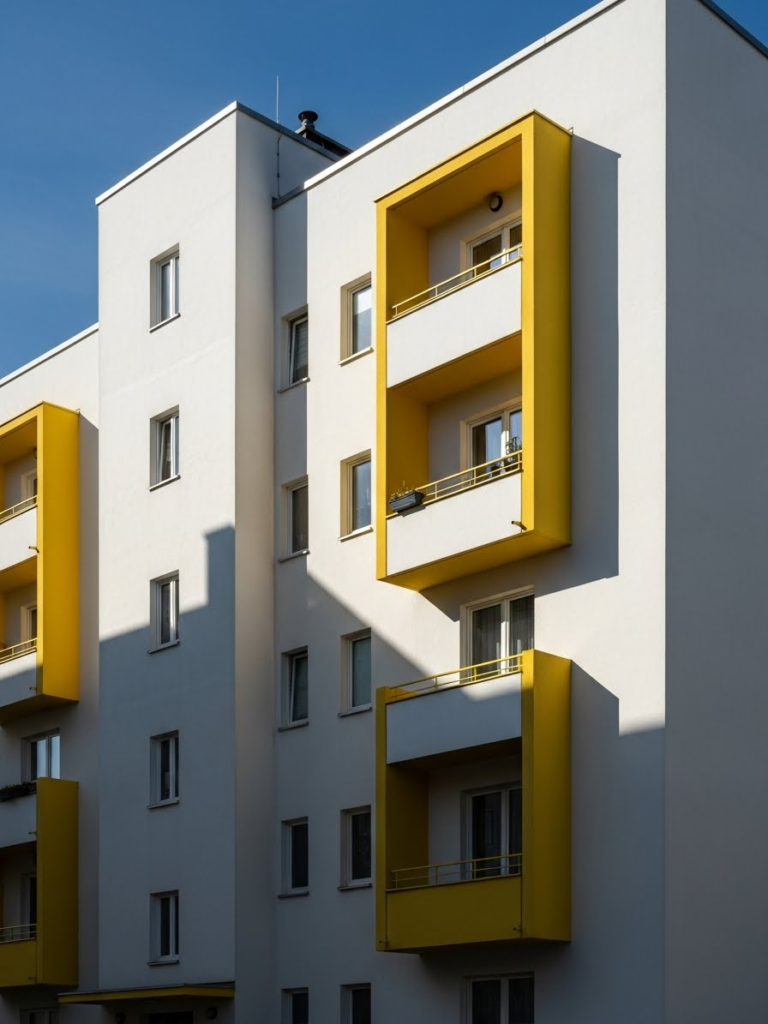
Bauhaus design principles—simple forms, functional planning, and strategic color—shape this facade. The white stucco provides a neutral backdrop while recessed balconies painted vibrant yellow add visual punctuation. The geometry is strict and orthogonal, with high-contrast shadows reinforcing the composition under strong sunlight.

The yellow balconies serve multiple purposes: they identify outdoor spaces clearly, create a repeating rhythm across the facade, and inject personality into an otherwise minimal design. Recessing the balconies protects them from weather while creating deep shadow lines that give the flat facade three-dimensional depth. This approach proves that even modest material palettes can produce striking results through careful proportion and selective color.
6. Vertical Forest with Timber Structure

Exposed structural timber columns running the full height of the building create a strong vertical rhythm while supporting deep planters on every balcony. The combination produces a “vertical forest” effect where greenery becomes integral to the facade. A moody, foggy atmosphere emphasizes the building’s relationship with nature.

Timber structure visible on the exterior makes the building’s construction logic legible and communicates sustainability values directly. The deep planters aren’t decorative—they require structural support and irrigation systems built into the building’s core design. This level of integration means the greenery can mature into substantial vegetation rather than remaining token planting, fundamentally changing how the building ages and appears over time.
7. Industrial Conversion with Contemporary Insertions

Adaptive reuse of an old factory retains the original red brick facade while inserting modern steel and glass box balconies that cantilever from the existing structure. The contrast between old and new materials creates a layered reading of the building’s history. A cobblestone street in the foreground reinforces the industrial context.

This approach respects the existing building’s character while clearly marking contemporary interventions. The transparency of the glass boxes allows the brick facade to remain visible behind them, maintaining the building’s original proportions and rhythm. The steel frame technology makes these additions possible without compromising the historic structure, demonstrating how preservation and modernization can coexist.
8. Diagrid Exoskeleton in Glass and Steel

A diagrid—a diagonal grid structural system—wraps the building’s exterior in white steel, creating both the structure and the facade pattern simultaneously. The glass curtain wall behind reflects surrounding buildings and clouds, dematerializing the tower’s mass. The low-angle view emphasizes the structure’s geometric complexity and height.

Diagrid systems are structurally efficient because diagonal members handle both vertical loads and lateral forces from wind, reducing the amount of steel needed compared to traditional column-and-beam systems. The visual result is a distinctive diamond pattern that gives the building identity while honestly expressing its structural logic. The white steel creates a crisp frame against the reflective glass, making the system easy to read from street level.
9. Perforated Copper Screen as Light Filter
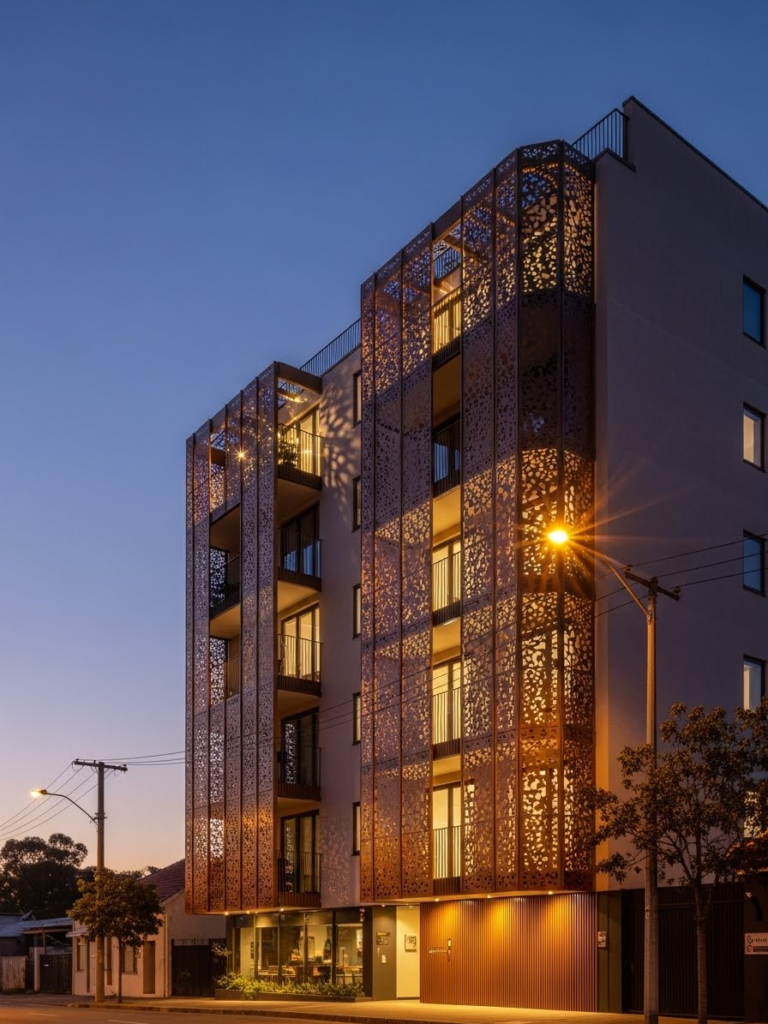
A facade of perforated copper panels wraps this small apartment building, filtering daylight into units while creating privacy from the street. At twilight, interior lighting transforms the building into a glowing lantern, with light escaping through the perforations. The copper will patina over time, adding another layer of visual evolution.
The perforation pattern controls the balance between openness and enclosure—larger holes provide views and ventilation, while the overall density of the screen maintains privacy. Copper’s natural weathering means the facade will shift from bright metallic to green patina, creating a living finish that responds to local climate. This material choice connects the building to traditional architectural uses of copper while employing contemporary fabrication techniques.
10. Brutalist Rhythm Softened by Interior Light
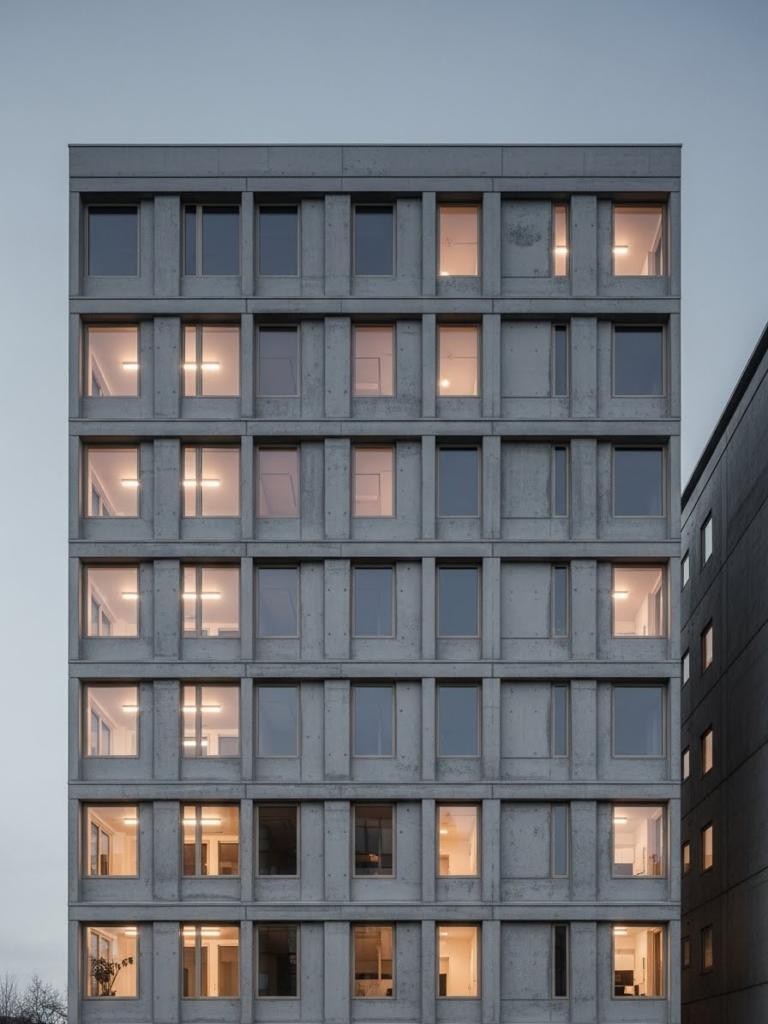
Strict rhythmic fenestration defines this concrete facade, where every window is an identical floor-to-ceiling square arranged in a precise grid. The raw brutalist aesthetic comes from exposed concrete and the rejection of decoration. Warm interior lighting visible through the glass softens the exterior’s austerity.
Brutalism’s power lies in its honesty—the concrete isn’t hidden, the structure is straightforward, and the repetition creates order rather than variety. The floor-to-ceiling windows maximize natural light inside while creating a strong pattern on the exterior. The contrast between the cold, raw concrete and the warm glow from within demonstrates how inhabited space humanizes even the most severe architectural gestures.
11. Stepped Terraces for Coastal Living
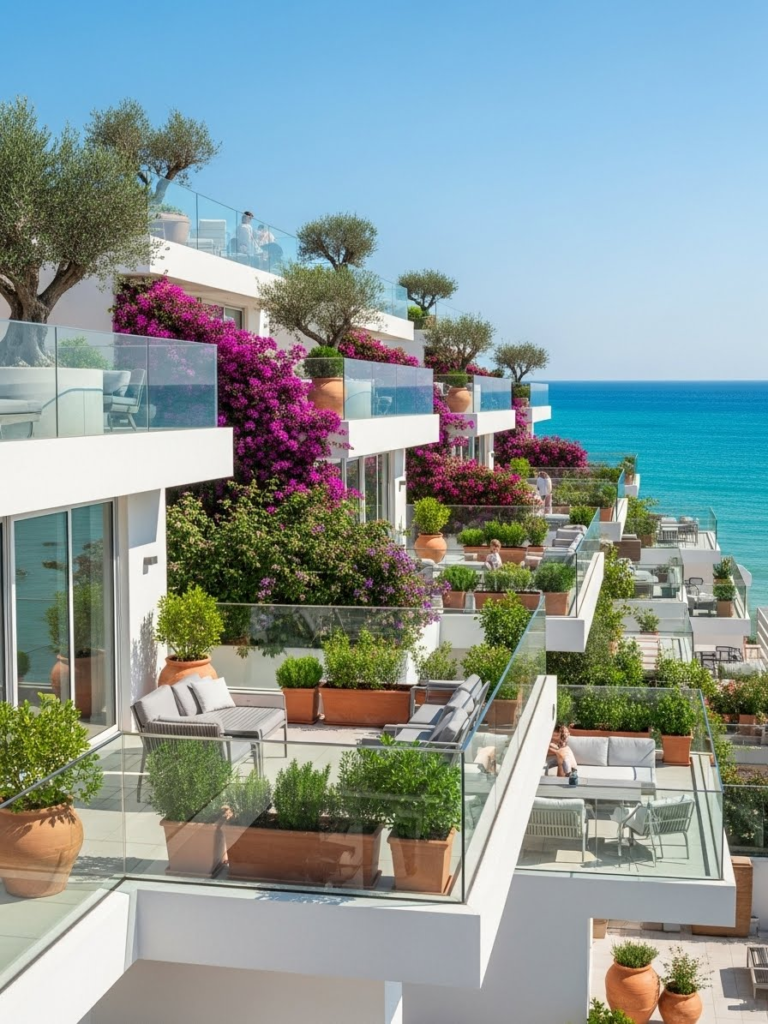
Each floor steps back from the one below, creating a pyramidal profile that gives every apartment a substantial roof terrace. White rendered walls and glass railings maintain a clean, Mediterranean aesthetic. This massing strategy maximizes outdoor space and solar access in a coastal climate.

The stepped section serves multiple functions: it reduces the building’s apparent mass from the street, ensures each terrace receives full sunlight, and prevents upper-level residents from overlooking lower apartments. In coastal areas, these protected outdoor spaces are essential for capturing sea breezes while providing shelter from strong winds. The white render reflects heat and enhances the bright, airy character appropriate to the climate.
12. Urban Infill with Layered Privacy

Dark grey zinc panels form the primary facade, with vertical wooden fins layered in front to provide privacy without blocking light completely. The entrance is marked by a golden canopy that stands out against the muted material palette. Wet pavement reflects the building, emphasizing its urban context.
This layered facade system addresses the challenge of urban infill sites where buildings sit close to busy streets. The zinc provides weather protection and durability, while the wooden fins create a buffer zone that filters views and reduces noise. The golden canopy serves as a clear wayfinding element, solving the common problem of anonymous apartment entrances. The material contrasts—industrial metal, natural wood, and precious-metal-toned accent—create hierarchy and interest.
13. Curved Glass Corner Expression

The building addresses its corner site with a sweeping curve of glass that wraps the intersection, creating a landmark at the urban scale. Horizontal white bands accentuate each floor plate, emphasizing the building’s height and the continuity of the curve. Blurred cars in the foreground suggest urban energy.
Corner sites demand architectural attention because they’re visible from multiple directions and often anchor important intersections. The curved glass solution avoids awkward corner angles and instead creates a fluid gesture that feels appropriate to movement and flow. The horizontal banding provides scale—without it, the glass could read as a single undifferentiated surface—and ties the curved and flat portions of the facade together.
14. Natural Stone and Bronze Elegance

Travertine stone cladding and bronze-anodized aluminum window frames create a restrained, elegant facade. Juliet balconies with intricate railings add detail at the human scale. The material choices emphasize permanence and quality through natural stone and durable metal finishes.
Travertine’s natural color variation and texture provide visual interest without applied pattern or color. The bronze anodizing process creates a stable finish that won’t corrode, while its warm tone complements the stone. Juliet balconies—shallow balconies where the door opens but there’s minimal floor area—solve the challenge of providing operable windows for ventilation and light while maintaining the facade’s flatness. The intricate railings concentrate detail where residents interact with them most.
15. Colorful Mosaic for Student Housing

Fiber cement panels in shades of blue and green arrange in a seemingly random mosaic across the facade, creating a playful, approachable character appropriate for student housing. Bike racks in front acknowledge the transportation needs of the residents. The sunny day and bright colors convey energy and youth.
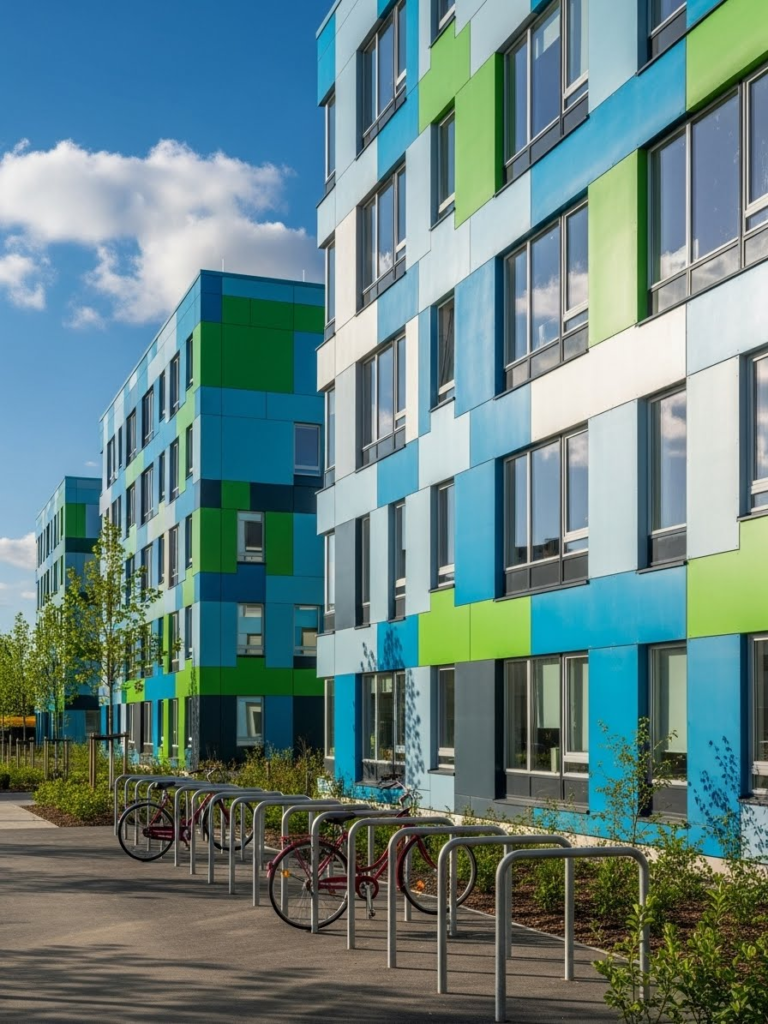
Student housing benefits from visual differentiation—both to create identity and to help residents navigate large complexes. The color strategy here is bold without being childish, using a related color palette that feels cohesive despite the varied arrangement. Fiber cement is a practical choice for this building type: durable, low-maintenance, and cost-effective compared to more expensive cladding systems, while still allowing color and pattern.
16. Alpine Architecture for Mountain Context

Heavy timber logs, stone bases, and pitched roofs with dormers translate traditional alpine construction into a larger apartment building. Snow sits on the roof while warm light glows from windows, emphasizing the building’s role as shelter in a harsh climate. The design respects mountain vernacular architecture.
This approach demonstrates how regional building traditions can scale up to contemporary densities. The heavy timber construction provides both structural support and insulation, essential in mountain climates. Stone bases protect the building from snow accumulation and water damage while grounding it visually. The pitched roofs and dormers aren’t decorative—they shed snow effectively and provide usable space under the roofline. The warm window glow creates a beacon effect that’s both practical and emotionally resonant in snowy conditions.
17. Organic 3D-Printed Forms

The facade appears as organic, biological forms that could have been grown rather than built, realized in bone-white 3D-printed concrete. Soft, diffused lighting eliminates harsh shadows, emphasizing the smooth, flowing surfaces. This represents an exploration of how digital fabrication might enable entirely new formal languages.
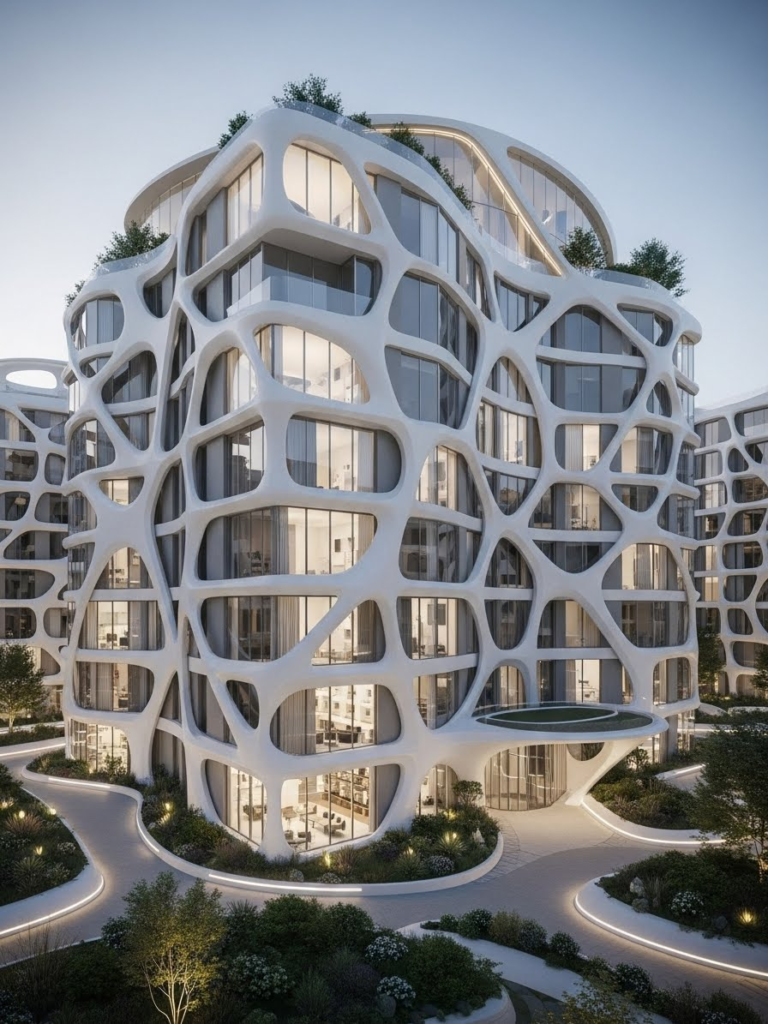
Three-dimensional concrete printing allows complex curves and flowing forms that would be prohibitively expensive with traditional formwork. The biological inspiration suggests structures optimized for performance—like bones that distribute loads efficiently through their shape—rather than conforming to orthogonal building conventions. The monochromatic white emphasizes form over material, keeping focus on the sculptural qualities.
18. Checkerboard Solid and Void

A strict checkerboard pattern alternates between solid wall surfaces clad in dark blue ceramic tiles and open voids that function as balconies. The symmetrical composition emphasizes order and rhythm, creating a strong graphic quality. This binary approach to facade composition makes the building’s organization immediately legible.

The checkerboard strategy clearly differentiates served and service spaces—the solid squares likely contain kitchens, bathrooms, and storage, while the voids provide outdoor access. Dark blue ceramic tiles are durable, weather-resistant, and maintain their color without fading, making them practical for exterior applications. The symmetry and repetition give even a modest building a sense of monumentality and intention.
19. Connected Towers with Mirrored Glass

Two residential towers linked by a skybridge create a gateway form at the urban scale. Both facades are mirrored glass, reflecting the sunset and surrounding sky. This glazing strategy dematerializes the building’s mass, making the towers appear lighter than their actual size.
Skybridge connections provide shared amenities, structural stability, and architectural drama. The mirrored glass serves multiple functions: it reduces solar heat gain, provides privacy for residents, and creates constantly changing visual effects as light conditions shift. At sunset, the towers become surfaces for reflected color, turning them into active participants in daily atmospheric changes rather than static objects.
20. Garden Apartments with Green Integration

Low-rise garden apartments feature facades covered in ivy and wooden trellis systems, creating an intimate, green-focused living environment. Direct access from the street to individual units creates a house-like quality. The scale is intentionally residential rather than institutional.
This building type prioritizes ground-level connection and greenery over density. The ivy coverage provides natural insulation, reduces urban heat island effects, and creates seasonal variation as leaves change. Wooden trellis work guides plant growth while adding texture and shadow patterns. The two-story height maintains compatibility with traditional residential neighborhoods while still providing efficient multi-family housing.
21. Collage of Materials

Concrete, Corten steel, and wood appear as distinct panels across the facade in a composition that reads as chaotic at first but reveals underlying balance. Each material maintains its natural finish and color. The artistic approach suggests architecture as assemblage.
This collage technique makes the building’s construction process visible—different materials arrive at different times, get installed by different trades, and age differently. Corten steel develops a protective rust patina, wood weathers to grey, and concrete maintains its cast texture. Rather than hiding these material differences behind a unified finish, the design celebrates them as essential to the building’s character.
22. Nautical-Inspired Waterfront Living

Expansive frameless glass balconies and white curved forms evoke nautical design, appropriate for the waterfront location. Water reflections at the bottom of the frame emphasize the building’s relationship with its site. The transparency maximizes water views for residents.

Frameless glass systems use structural glass with minimal metal clips rather than traditional railings, creating nearly uninterrupted views. The white curves reference yacht design and other marine architecture, establishing thematic connection to the water. Waterfront locations demand this level of transparency—obstructing the view defeats the primary reason for the site’s value. The reflections create visual continuity between building and water.
23. Vertical Emphasis in Dense Context

A narrow “pencil tower” maximizes height on a constrained urban footprint. The facade emphasizes verticality through long strip windows that run the full height of each floor, making the building feel even taller. Viewing from the base looking upward intensifies the soaring quality.
Pencil towers emerge in dense cities where lot sizes are small but height limits are generous. The vertical strip windows serve multiple purposes: they provide natural light to deep floor plates, create a distinctive pattern that differentiates the building from wider towers, and emphasize height psychologically. This building type requires careful structural engineering to handle wind loads on such a slender profile.
24. Art Deco Revival with Contemporary Lighting

Geometric relief patterns carved into stonework and brass decorative elements revive Art Deco design language in a contemporary building. Night uplighting emphasizes the facade’s three-dimensional detail and metallic accents. The style reference is clear but not slavishly historical.

Art Deco’s emphasis on geometry, vertical lines, and luxurious materials makes it adaptable to modern construction. The stone relief work creates shadow patterns during the day and becomes dramatic under night lighting. Brass elements add warmth and precious-metal luxury associations. Uplighting—light directed from ground level upward—is practical for highlighting facade detail while avoiding glare into apartments.
25. Dignified Social Housing

Simple brick construction and brightly colored window frames create a dignified, high-quality appearance for social housing. A community courtyard visible in the foreground provides shared space for residents. The design rejects the institutional aesthetic often associated with affordable housing.

Quality social housing demonstrates that limited budgets don’t require aesthetic compromise. Brick is durable and relatively affordable while providing natural color variation and texture. The colored window frames add individuality and cheer at minimal cost—paint is inexpensive but transformative. The courtyard creates semi-private community space that encourages social interaction, addressing the isolation that can occur in large residential developments.
26. Dynamic Solar Shading

Horizontal metal louvers angle differently on each floor, creating a dynamic pattern of solar shading. The system has a high-tech aesthetic, with the louvers reading as precise, engineered elements. This approach makes climate response visually explicit.
Angled louvers block direct sun while allowing diffused light and views, improving interior comfort and reducing cooling loads. Different angles on each floor optimize shading for sun position and unit orientation—south-facing units need more protection, upper floors receive more intense sunlight. Making this system visible on the exterior demonstrates environmental performance as an architectural feature rather than hiding mechanical solutions behind conventional facades.
27. Village-Like Massing

A massive residential program breaks down into smaller volumes that stack and connect, each with its own roof pitch and color. The result feels whimsical and village-like rather than monolithic. This massing strategy addresses the psychological challenge of large-scale housing.
Breaking mass into smaller pieces creates visual interest and human scale even when the overall building is substantial. Varied roof pitches allow snow shedding, rainwater management, and the possibility of pitched-roof apartments with character. Different colors help residents identify their section within the larger complex and create neighborhood-like identity within a single building.
28. Tropical Climate Response

Deep overhangs, bamboo screens, and open-air corridors respond directly to tropical climate conditions. Lush vegetation surrounds the base, blurring the boundary between building and landscape. The design prioritizes natural ventilation and shade over air conditioning.

Tropical architecture must manage intense sun and humidity without relying entirely on mechanical systems. Deep overhangs block direct sunlight from entering units while allowing air circulation. Bamboo screens filter light and provide privacy while remaining permeable to breezes. Open-air corridors eliminate the need for conditioned circulation spaces, reducing energy use. The integrated vegetation cools the microclimate through evapotranspiration and provides psychological benefits.
29. Classical and Contemporary Dialogue

A Haussmann-style building—the ornate 19th-century Parisian apartment typology—receives a modern glass attic addition. The contrast between the detailed stone lower floors and the sleek glass top creates dialogue between historical and contemporary design. Both periods remain legible.
This renovation strategy adds density and contemporary space while preserving historical character. The glass addition sits back from the street facade, maintaining the building’s original cornice line and street presence. The transparency of the new floor differentiates it clearly from the stone base, avoiding false historicism. This approach demonstrates respect for existing architecture while allowing cities to evolve and densify.
30. Honeycomb Geometry

Hexagonal honeycomb balconies create a geometric pattern across the facade. The structure is white concrete, while the interiors of the balconies are painted terracotta, creating color contrast visible from the street. The hexagonal geometry is both structural and decorative.
Honeycomb structures are inherently efficient—they distribute loads evenly and minimize material use while creating strong forms. Applying this geometry to balconies produces distinctive outdoor spaces with multiple orientations and interesting sight lines between units. The terracotta interiors warm the otherwise neutral white facade and become visible as residents use their balconies, creating a shifting pattern of occupied and unoccupied spaces throughout the day.
0 Comments